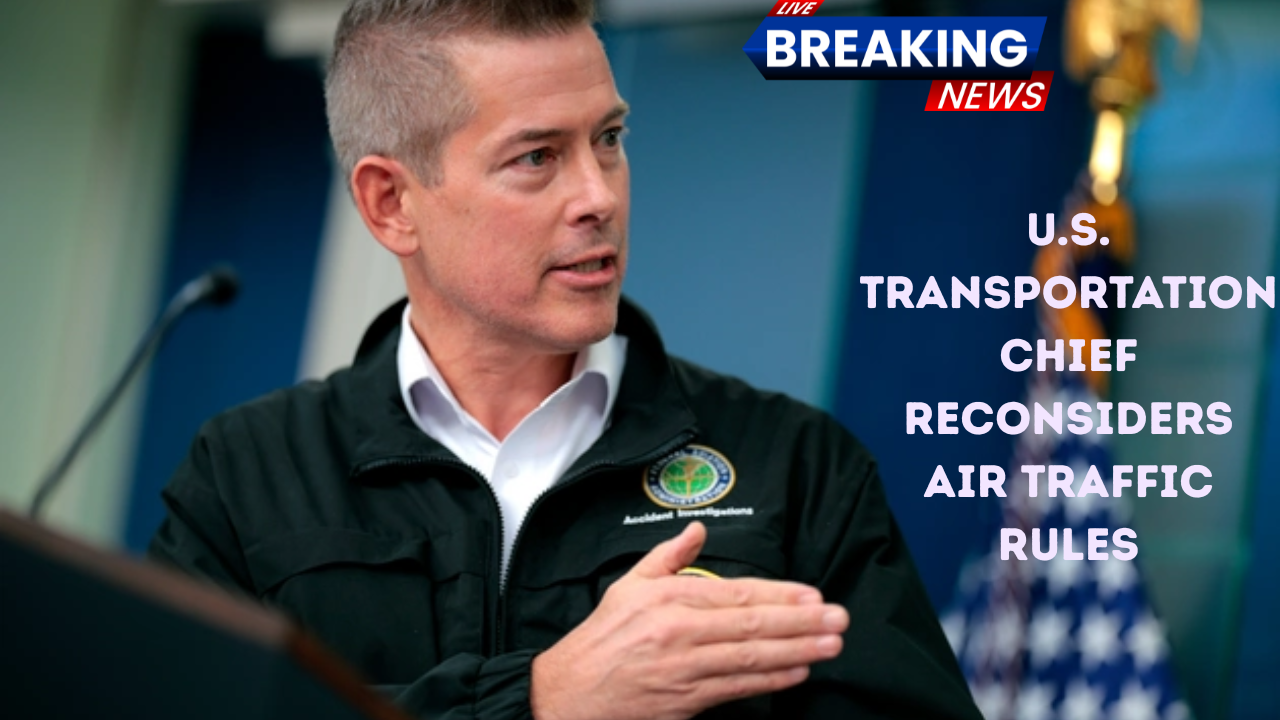
The U.S. transportation chief’s decision to reconsider air traffic rules comes in the shadow of the deadliest aviation disaster in the country in more than two decades, involving a collision between a passenger jet and a U.S. Army helicopter near Washington, D.C., that killed 67 people. The tragedy exposed long‑standing weaknesses in America’s air traffic system, from outdated technology to chronic staffing shortages, and created intense political pressure for visible, fast reforms.
U.S. Transportation Secretary Sean Duffy has responded by signaling a sweeping review of regulations that allowed air traffic control staffing to be reduced at Washington’s Reagan National Airport before the fatal crash. He has also ordered temporary restrictions on helicopter operations around the airport while investigators and regulators reassess how military and civilian aircraft share crowded urban airspace.

Why Sean Duffy Is Reconsidering Air Traffic Rules
Duffy has made clear that he is questioning the rules that let supervisory staff merge key controller positions, leaving a single controller managing both airplane and helicopter traffic at the time of the crash. He has said that authority to make such consolidations will be “taken back” so that safety‑critical staffing decisions are governed by stricter national standards instead of local discretion.
He has also highlighted how low‑flying military helicopters, operating close to busy civilian corridors, can create unacceptable risks when procedures are lax or training flights are scheduled at unsuitable times. In particular, officials noted that the Army helicopter involved in the collision was flying above the usual altitude limit on that route, a detail that has intensified calls to tighten rules for military operations in congested airspace.

Bringing Elon Musk Into the Conversation
In a move that has attracted worldwide attention, Duffy has opened discussions with Elon Musk about how to remake U.S. airspace management and modernize air traffic control. Musk, now a prominent efficiency advisor in the Trump administration and best known as the head of SpaceX and other technology companies, has long argued that the Federal Aviation Administration (FAA) is overly bureaucratic and slow to adopt modern systems.
Duffy says that Musk’s team will help develop rapid safety upgrades for air traffic control and support a broader modernization push. Musk has echoed that message on his social platform, saying SpaceX engineers will work to make air travel safer and more technologically advanced, particularly after recent failures in FAA alerting systems and years of criticism over aging infrastructure.
The State of America’s Air Traffic System
The U.S. air traffic control network still depends on decades‑old technology in many facilities, despite repeated promises from both Republican and Democratic administrations to modernize it. Airline executives and aviation safety experts have argued for years that radar‑based tracking, legacy radios, and slow data systems should be replaced with satellite‑based navigation and digital communications to cut delays and reduce near‑miss risks.
At the same time, the FAA faces a serious staffing shortfall, with estimates suggesting a deficit of around 3,000 controllers and widespread overtime and fatigue in towers and centers across the country. Recent layoffs tied to broader federal workforce cuts, and internal restructuring that eliminated diversity and inclusion offices at the FAA, have intensified concerns among unions and lawmakers about overwork and morale.
Snapshot Of Key Air Traffic Challenges
| Issue | Current Situation (U.S.) | Why It Matters |
|---|---|---|
| Controller shortage | Roughly 3,000 fewer certified controllers than needed nationwide. | Increases overtime, fatigue, and risk of human error during critical operations. |
| Technology age | Many systems still rely on legacy radar and 20th‑century hardware. | Limits capacity, slows responses to emergencies, and complicates integration of new aircraft types. |
| Recent deadly crash | Collision near Washington, D.C., killed 67 people and exposed procedural gaps. | Intensified pressure on DOT and FAA to act quickly and visibly on safety reforms. |
| Private‑sector involvement | Musk and SpaceX engineers invited to help review air traffic systems. | Could speed innovation but raises concerns about conflicts of interest and oversight. |
Political Tensions And Public Debate
The renewed focus on air safety has reignited partisan arguments over who is to blame for the current state of the system. Duffy has criticized the prior administration under Pete Buttigieg for not doing enough to solve staffing shortages and modernize technology, while Buttigieg has responded that he launched major upgrades and that current problems reflect new policy choices.
Lawmakers and unions are also debating the role Musk should play. Some Democrats have urged Duffy to bar Musk from direct involvement in FAA reform, citing potential conflicts of interest because his companies rely on FAA approvals, while others in the Trump camp praise Musk’s reputation for rapid innovation and cost‑cutting. This tension will likely shape how far and how fast the administration can move in handing design influence or implementation work to private technology teams.

What Reform Could Look Like
Duffy has promised new investments to expand air traffic control training pipelines and bring more candidates into the profession, though he acknowledges that it will take time before new hires fully qualify. He has also signaled support for major funding packages—tens of billions of dollars over several years—to build new control centers, update thousands of navigation and communication sites, and overhaul software across the network.
In parallel, Musk’s engineers are expected to review how data flows through the system, from radar and satellite feeds to alerts that warn controllers about potential collisions. Their mandate, as publicly described, is to identify quick safety wins and propose more radical redesigns that could allow the United States to leapfrog to a next‑generation, highly automated traffic management model, while still leaving regulatory authority with the FAA.
Opportunities And Risks Of Musk’s Involvement
Many passengers and industry leaders welcome the idea of fresh thinking and faster timelines after years of delay and incremental upgrades. Musk’s track record in rocketry and satellite networks suggests he can drive large engineering teams to deliver complex systems quickly, and his influence with President Trump and other senior officials could help secure both political support and funding.
However, critics warn that bringing a powerful private figure inside the reform process could blur lines between regulator and regulated, especially when that figure controls companies subject to FAA oversight. There are also fears that cost‑cutting efforts linked to Musk’s Department of Government Efficiency could undermine safety by pushing for aggressive staffing reductions or automation before new systems are proven and widely tested.
What This Means For Travelers
In the short term, travelers around Washington, D.C., and other major hubs can expect ongoing schedule disruptions as helicopter procedures change and temporary restrictions remain in place. Over the longer term, if Duffy’s modernization plans and Musk‑assisted upgrades succeed, passengers could see fewer delays, better handling of storms and congestion, and stronger safeguards against both mid‑air and runway collisions.
Yet the path ahead will depend on how Congress reacts, how regulators balance speed with caution, and whether public trust is maintained as reforms unfold. The debate over who should shape America’s skies—career regulators, elected officials, or disruptive technologists—will likely continue well beyond the current crisis, even as the shared goal of safer, more reliable air travel remains non‑negotiable.
SOURCE
FAQs
Q1: Why is the transportation chief reconsidering air traffic rules?
A1: He is responding to a deadly crash near Washington, D.C., along with concerns about outdated technology and understaffed control towers.
Q2: What role will Elon Musk play in airspace reform?
A2: Musk’s team will help review and modernize air traffic control systems, focusing on rapid safety upgrades and new technology solutions.
Q3: Will these reforms affect flight delays?
A3: In the near term there may be disruptions, but successful modernization could reduce delays and improve overall reliability over time.