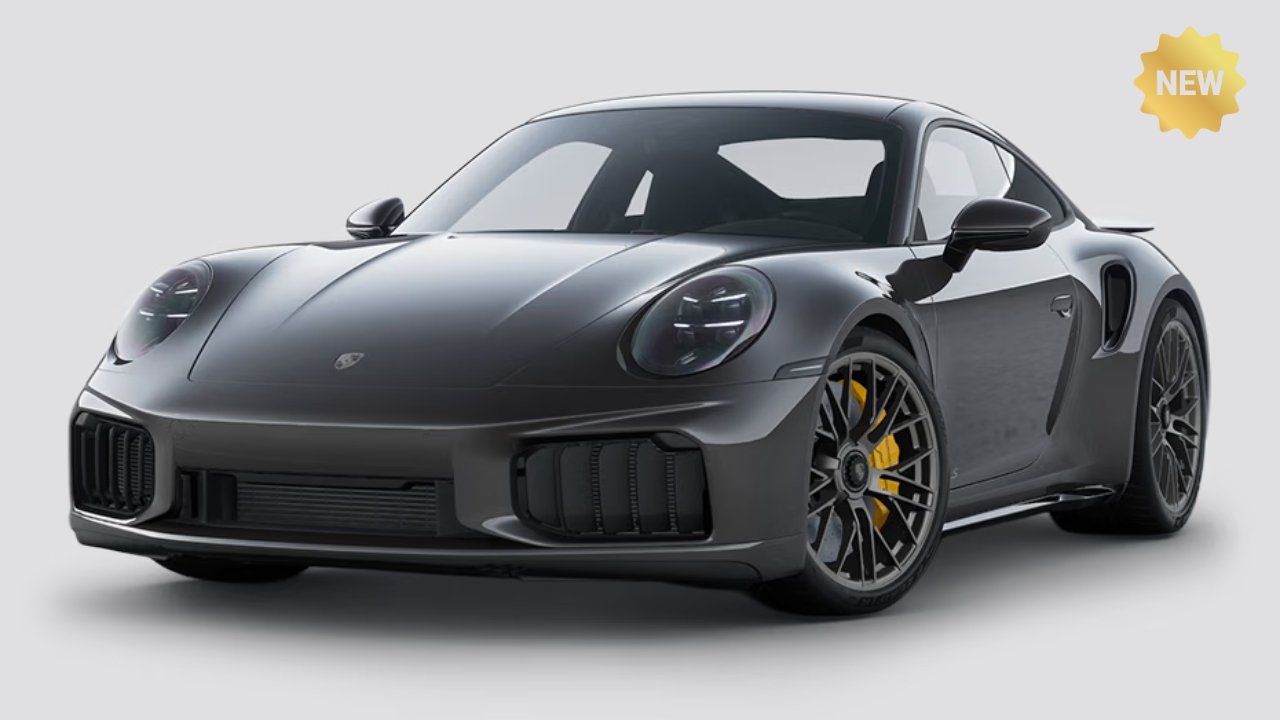
Porsche has filed a patent for a compact axial-flux hybrid drivetrain that slots an ultra-thin electric motor between the engine and a dual-clutch transmission, signaling a lighter, sharper path for upcoming performance models such as the 911 and GT cars. The filing describes an axial “flow” machine packaged in its own bell housing with dedicated cooling, enabling hybrid assist without the mass and inertia penalties of current radial-flux PDK-integrated motors used on Cayenne and Panamera hybrids.
[1][2][3]
Why axial flux matters
- Axial-flux e-motors deliver higher power density and torque in a pancake form factor, reducing length and weight versus radial-flux units—ideal for rear-engined, space-critical sports cars like the 911.[3]
- The patent outlines thermal management upgrades to keep the motor at optimal temperature under track loads, which is crucial given sustained high output and tight packaging near the clutch and flywheel.[1][3]
- Porsche’s approach pairs the axial motor exclusively with a DCT because its longer input shaft and housing volume simplify packaging and allow robust torque transfer during blended ICE-EV operation under high loads.[2]
Potential applications
The layout could let Porsche retain naturally aspirated flat-six character in future GT3/RS while adding electric torque fill, launch boost, and energy recuperation—mitigating emissions without resorting to turbos on halo track models, according to analyses of the filing’s intent and Porsche’s public statements about GT electrification needs.
[3]
Compared with today’s 911 T-Hybrid layout, an axial motor could trim mass, shorten driveline length, and shift weight distribution favorably, enhancing transient response and steering feel—key GT attributes Porsche is keen to preserve.
[3]
How it differs from rivals
Ferrari, Lamborghini, McLaren, and Mercedes (via YASA) already exploit axial-flux motors for compact, high-output hybrids; Porsche’s patent indicates it plans to engineer its own axial package rather than buy off-the-shelf, a heavy lift but one that aligns with Weissach’s emphasis on in-house driveline integration and durability for track use.
[3]
YASA’s latest axial motor benchmarks (sub-3-inch thickness, extreme specific output) illustrate why this topology is attractive; Porsche tailoring the design for rear-engine packaging and DCT coupling marks a distinctive direction within the segment.
[3]
What the patent describes
- Axial-flux machine placed between ICE and DCT in a dedicated bell housing, with a reinforced clutch pack and updated lubrication/cooling circuits to handle regenerative and boost loads repeatedly on circuit.[1][3]
- Control strategies for smooth torque blending, launch assist, and regenerative braking calibrated for rear-drive balance and ESC/TC systems—targeting driver feel consistent with Porsche GT dynamics rather than pure headline power.[1][3]
- The filing explicitly favors a DCT for packaging and durability; manuals are not referenced, underscoring Porsche’s focus on high-performance hybridization with seamless shift logic.[2]
Timeline and outlook
There’s no production date in the filing, but experts suggest this axial setup could underpin the next wave of hybrid 911s beyond today’s T-Hybrid, and potentially future GT models that must adopt electrification or turbocharging to meet regulations—Porsche has hinted at that crossroads before.
[3]
If realized, the axial system could raise system output while cutting mass and improving lap-sustained performance, positioning Porsche to compete with axial-equipped rivals without sacrificing the signature 911 driving character.
[1][3]
Bottom line
Porsche’s axial-flux hybrid patent points to a purpose-built, lightweight electric assist module tailored to the packaging and dynamic demands of rear-engine sports cars. By moving to a thin, high-power motor with dedicated cooling and DCT integration, Porsche is laying groundwork for hybrids that feel more analog—faster response, less mass, better balance—while delivering the efficiency and performance gains modern regulations demand.
[2][1][3]